


The PDF of the wave height or wave crest distribution was assumed as the Weibull
distribution by Eq.(9), and the overtopping volume  per wave was
assumed to follow Eq.(14).
Substituting Eq.(14) into Eq.(9) gives the
PDF of overtopping as a function of the normalized overtopping volume
per wave was
assumed to follow Eq.(14).
Substituting Eq.(14) into Eq.(9) gives the
PDF of overtopping as a function of the normalized overtopping volume
 , we have the exceedance
probability of on the deck given by
, we have the exceedance
probability of on the deck given by
 by
Eq.(9) is normalized by the rms value of , and the normalized
wave amplitude has a linear relationship with the overtopping volume
by Eq.(13).
As a result, the overtopping volume in Eq.(15) and
(16) is normalized by the rms value of .
It is worth noting that the number of statistical events (overtopping events)
depends on
the deck level due to the transformation of variable from to
using Eq.(14).
Physically, this means that the probability of overtopping volume has
zero value below
by
Eq.(9) is normalized by the rms value of , and the normalized
wave amplitude has a linear relationship with the overtopping volume
by Eq.(13).
As a result, the overtopping volume in Eq.(15) and
(16) is normalized by the rms value of .
It is worth noting that the number of statistical events (overtopping events)
depends on
the deck level due to the transformation of variable from to
using Eq.(14).
Physically, this means that the probability of overtopping volume has
zero value below  .
Therefore, number of overtopping events is different from number of
incident wave events.
.
Therefore, number of overtopping events is different from number of
incident wave events.
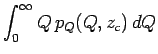
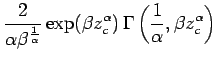
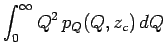
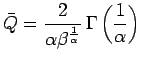
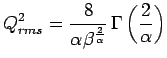
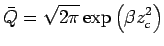
The mean and rms values of the overtopping volume in Eq.(15) are given by
In the case of  =0, the deck level is equal to the still water level (SWL),
and the PDF and exceedance probability can be simplified as
=0, the deck level is equal to the still water level (SWL),
and the PDF and exceedance probability can be simplified as
Thus, the PDF of the modified Weibull overtopping distribution has a similar profile compared to the Rayleigh distribution for wave amplitude.
This implies that wave nonlinearities (or spectrum band width) directly
affects the overtopping volume via
 in Eq.(15) to (22).
For the special case of =2 and  =1/2 which is the Rayleigh
condition for the wave amplitude distribution, Eq.(15)
and (16) are simplified as
=1/2 which is the Rayleigh
condition for the wave amplitude distribution, Eq.(15)
and (16) are simplified as
as
|
=10cm
![\epsfbox[50 192 557 610]{figures/theoryBVpQdQa200.eps}](img65.png)
![\includegraphics[width=10.0cm]{figures/theoryBV_pQdQ_a200.eps}](img67.png)
(a) =2.0
=10cm ![\epsfbox[50 192 557 610]{figures/theoryBVpQdQa150.eps}](img66.png)
![\includegraphics[width=10.0cm]{figures/theoryBV_pQdQ_a150.eps}](img68.png)
(b) =1.5 |
|
=10cm
![\epsfbox[50 192 557 610]{figures/theoryBVpQdQz000.eps}](img69.png)
![\includegraphics[width=10.0cm]{figures/theoryBV_pQdQ_z000.eps}](img71.png)
(a) =0
=10cm ![\epsfbox[50 192 557 610]{figures/theoryBVpQdQz100.eps}](img70.png)
![\includegraphics[width=10.0cm]{figures/theoryBV_pQdQ_z100.eps}](img72.png)
(b) =1 |
Having developed a theoretical framework for the
statistical modeling of the overtopping via Eq.(15) to (26), the
qualitative tendency of the distributions can now be explained.
Fig.3 shows the PDF of the modified Weibull overtopping distribution as a function of deck level with =2.0 and 1.5,
where the value of =2.0 indicates the Rayleigh (linear random
wave) condition for the incident waves and  indicates extreme
nonlinear condition.
As the deck height increases, the peak of the PDF shifts to
lower values of until it eventually reaches a peak at =0.
The PDF of becomes a monotonically decreasing function for
indicates extreme
nonlinear condition.
As the deck height increases, the peak of the PDF shifts to
lower values of until it eventually reaches a peak at =0.
The PDF of becomes a monotonically decreasing function for  for the case of
  .
Fig.4 shows the PDF of the modified Weibull overtopping distribution as a function of
with =0 and 1.0.
As the value of decreases, the tail of the PDF increases.
Thus, the exceedance probability of larger value of increases for
.
Fig.4 shows the PDF of the modified Weibull overtopping distribution as a function of
with =0 and 1.0.
As the value of decreases, the tail of the PDF increases.
Thus, the exceedance probability of larger value of increases for
 in comparison with the case of
  .
The PDF of the wave amplitude and overtopping volume , Eq.(9)
and (15), have a similar exponential decay for large
values of and , respectively.
Therefore, the PDF of the modified Weibull overtopping volume shows
a tendency similar to that of the PDF of wave amplitude .
.
The PDF of the wave amplitude and overtopping volume , Eq.(9)
and (15), have a similar exponential decay for large
values of and , respectively.
Therefore, the PDF of the modified Weibull overtopping volume shows
a tendency similar to that of the PDF of wave amplitude .
Fig.5 shows
the sensitivity of the exceedance probability
of the modified Weibull overtopping distribution
on for the case of =1.0.
With a change in from =1.5 to =2,
the exceedance probability of
decreases one order of magnitude
at  and two orders of magnitude
at
and two orders of magnitude
at  .
Fig.6 shows
the sensitivity of the exceedance probability of to
the deck level for the case of =2.0. With a change of
from =0 to =2, the
exceedance probability decreases one order of
magnitude at
.
Fig.6 shows
the sensitivity of the exceedance probability of to
the deck level for the case of =2.0. With a change of
from =0 to =2, the
exceedance probability decreases one order of
magnitude at  and two orders of magnitude
at
and two orders of magnitude
at  .
.
|
=12cm
![\epsfbox[50 185 547 592]{figures/case1HT.eps}](img88.png)
![\includegraphics[width=10.0cm]{figures/case1_H-T.eps}](img89.png)
|
|
=12cm
![\epsfbox[60 398 375 542]{figures/pltWGd.ps}](img90.png)
![\includegraphics[width=10.0cm]{figures/pltWGd.eps}](img91.png)
|
![\begin{displaymath}
p_Q(Q,z_c)dQ
=
\frac{\alpha\beta}{2}
\left(
\frac{1}{2}...
...{1}{2}Q + z_c\right)^{\alpha}
- z^\alpha
\right]
\right\}dQ
\end{displaymath}](img47.png)
![\begin{displaymath}
P_Q(Q,z_c)
=
\exp\left\{
-\beta\left[
\left(\frac{1}{2}Q + z_c\right)^{\alpha}
- z^\alpha
\right]
\right\}
\end{displaymath}](img49.png)



![$\displaystyle \frac{8}{ \alpha\beta^{ \frac{2}{\alpha}} }
\exp( \beta z_c^\alph...
...a
\right)
+
\Gamma\left(
\frac{ 2 }{ \alpha }, \beta z_c^\alpha
\right)
\right]$](img56.png)


![\begin{displaymath}
p_Q^R(Q,z_c)dQ
=
\frac{1}{4}
\left(
Q+2z_c
\right)
\exp\left[
- \frac{1}{8}
Q(Q+4z_c)
\right] dQ
\end{displaymath}](img61.png)
![\begin{displaymath}
P_Q^R(Q,z_c)
=
\exp\left[
- \frac{1}{8}
Q(Q+4z_c)
\right]
\end{displaymath}](img62.png)

![\epsfbox[50 185 547 592]{figures/theory2alphazc100.eps}](img82.png)
![\includegraphics[width=12.0cm]{figures/theory2_alpha_zc100.eps}](img83.png)
![\epsfbox[50 185 547 592]{figures/theory2zcalpha200.eps}](img84.png)
![\includegraphics[width=12.0cm]{figures/theory2_zc_alpha200.eps}](img85.png)
![\epsfbox[-137 124 751 667]{figures/tank.ps}](img86.png)
![\includegraphics[width=12.0cm]{figures/dtc_experiment.eps}](img87.png)
 and wave period
  .
.