


The overtopping volume,  , can be defined as the volume of water
column above the deck level, shown schematically
in Fig.1.
The overtopping volume only depends on spatial surface profile, if
the deck is thin compared to the incident wave amplitude.
Therefore, if the spatial wave profile is known, it is possible to
calculate the overtopping volume accurately.
However, there is some difficulty to estimate the spatial profile of
random waves.
Thus, the overtopping volume is calculated by the following assumptions and procedure.
First, the profile of the individual wave crest is assumed to be a sinusoidal wave locally.
Then, if the deck level
, can be defined as the volume of water
column above the deck level, shown schematically
in Fig.1.
The overtopping volume only depends on spatial surface profile, if
the deck is thin compared to the incident wave amplitude.
Therefore, if the spatial wave profile is known, it is possible to
calculate the overtopping volume accurately.
However, there is some difficulty to estimate the spatial profile of
random waves.
Thus, the overtopping volume is calculated by the following assumptions and procedure.
First, the profile of the individual wave crest is assumed to be a sinusoidal wave locally.
Then, if the deck level  is given and the crest amplitude
  is known, the
volume of water column above deck level, , is simply calculated by
is known, the
volume of water column above deck level, , is simply calculated by
 is the local wave number and is local amplitude of the wave.
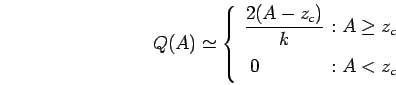
Eq.(11) can be roughly simplified for
is the local wave number and is local amplitude of the wave.
Eq.(11) can be roughly simplified for  as
as
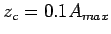
 = 0.1 and 0.5.
The transformation of the wave amplitude into overtopping volume by
the approximate
Eq.(12) becomes worse as the height of the deck level
= 0.1 and 0.5.
The transformation of the wave amplitude into overtopping volume by
the approximate
Eq.(12) becomes worse as the height of the deck level  increases.
The overtopping volume decreases as increases as expected.
Obviously, the assumptions of the local sinusoidal
wave crest profile and local wave number are only valid for narrow banded spectra.
The validity of the assumptions will be discussed later in
the context of the experimental results.
increases.
The overtopping volume decreases as increases as expected.
Obviously, the assumptions of the local sinusoidal
wave crest profile and local wave number are only valid for narrow banded spectra.
The validity of the assumptions will be discussed later in
the context of the experimental results.
The overtopping volume can be normalized by the rms value of surface
elevation  and wavenumber as
and is given by
 for , and will be dropped for
simplification hereafter.
All equations and variables are normalized by following section.
for , and will be dropped for
simplification hereafter.
All equations and variables are normalized by following section.
|
=12cm
![\epsfbox[50 185 547 592]{figures/theoryamplitudevolume.eps}](img45.png)
![\includegraphics[width=12.0cm]{figures/theory_amplitude-volume.eps}](img46.png)
|



 and
and  .
.