Wave data to be analyzed here were obtained by Ship Research Institute, Ministry of Transport, Japan.
Wave data were observed at 3km offshore from Yura port in Yamagata Pref., Japan sea.
Temporal sea surface elevations were observed with ultrasonic-type wave gages (UWG) installed on the sea bottom of about 43m mean water depth.
The observation periods are about 24 hours and sampling frequency is 1Hz.
The waves are generated under typical winter seasonal wind-field-conditions and the wave spectra therefore have  law.
The stationarities of the data are verified by statistical analysis, so that the temporal surface elevations to be analyzed here are satisfied stationarity.
The number of waves are about 10,000.
The typical statistical parameters are shown in Table 2.
The value of skewness is considerably small and the value of kurtosis is also close to the Gaussian.
Therefore, the waves are regarded as the weakly nonlinear waves with broad banded spectra.
law.
The stationarities of the data are verified by statistical analysis, so that the temporal surface elevations to be analyzed here are satisfied stationarity.
The number of waves are about 10,000.
The typical statistical parameters are shown in Table 2.
The value of skewness is considerably small and the value of kurtosis is also close to the Gaussian.
Therefore, the waves are regarded as the weakly nonlinear waves with broad banded spectra.
The exceedance probability of wave heights are shown in 10.
The filled circles 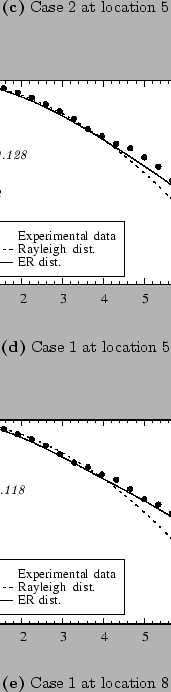 denotes the observed data, dotted line the Rayleigh distribution and solid line the Edgeworth-Rayleigh distribution.
The observed data show the tendency to agree with the Rayleigh distribution rather than the Edgeworth-Rayleigh distribution.
As already mentioned before, the waves are considerably weakly nonlinear, therefore, these disagreement with the Edgeworth-Rayleigh distribution might be caused by broad banded spectra of the field data.
We assumed to be obtained the wave height distribution that a wave height is regarded by two times of its amplitude.
This assumption is inadequate for such wind wave data.
denotes the observed data, dotted line the Rayleigh distribution and solid line the Edgeworth-Rayleigh distribution.
The observed data show the tendency to agree with the Rayleigh distribution rather than the Edgeworth-Rayleigh distribution.
As already mentioned before, the waves are considerably weakly nonlinear, therefore, these disagreement with the Edgeworth-Rayleigh distribution might be caused by broad banded spectra of the field data.
We assumed to be obtained the wave height distribution that a wave height is regarded by two times of its amplitude.
This assumption is inadequate for such wind wave data.
To verify the narrow banded spectrum assumption, the exceedance probability of wave amplitudes are shown in 11.
The filled circles denotes the crest distribution of observed data, the open triangles 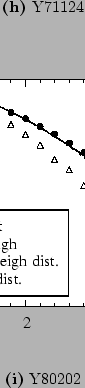 denotes the trough distribution of observed data, dotted line the Rayleigh distribution of amplitudes and solid line the Edgeworth-Rayleigh one.
The Edgeworth-Rayleigh distribution for the exceedance probability of wave amplitudes shows nice agreement with the crest amplitude of observed data in comparison with the Rayleigh distribution, although the trough amplitude distributions show the discrepancy between the theoretical distribution as increasing of the amplitude.
It requires improvements for further investigation.
denotes the trough distribution of observed data, dotted line the Rayleigh distribution of amplitudes and solid line the Edgeworth-Rayleigh one.
The Edgeworth-Rayleigh distribution for the exceedance probability of wave amplitudes shows nice agreement with the crest amplitude of observed data in comparison with the Rayleigh distribution, although the trough amplitude distributions show the discrepancy between the theoretical distribution as increasing of the amplitude.
It requires improvements for further investigation.