It has mentioned previously that the PDF of the surface elevation, wave amplitude, and wave height have weakly nonlinear properties. Some freak waves observed in the North Sea (Klinting and Sand, 1990) are characterized as a single and outstanding wave without a clear wave grouping. The wave grouping characteristics of the freak waves, however, can be very important for designing coastal, ocean structures, and sea-going ships. Therefore, the conventional run length approach (Kimura, 1980) for the wave grouping that contain freak wave cases is examined here and to compare the results with theoretical implications.
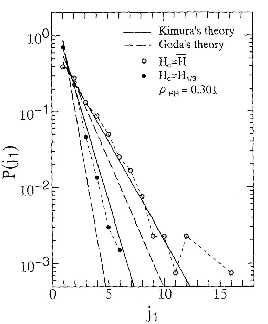
10 shows the run length distribution obtained from the wave data of the Y871124.
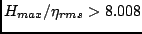
The solid circle, 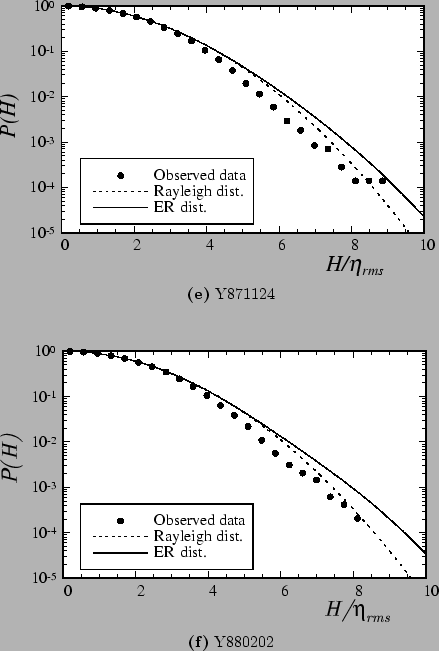 , indicates the distribution of the run length calculated from the case of
  =
=
 and the open circle,
  , indicates the case of =
 and the solid and dashed line indicate Kimura's and Goda's theories (Kimura, 1980), respectively.
 in the figure denotes the correlation coefficient of the succeeded wave heights.
All of the observed data of were about 0.3-0.4.
10 indicates that the run length including the freak waves generally agree with the Kimura theory in both cases, because the wave height distributions follow the Rayleigh distribution, eventhough the amplitude distributions do not agree with the Rayleigh theory.
in the figure denotes the correlation coefficient of the succeeded wave heights.
All of the observed data of were about 0.3-0.4.
10 indicates that the run length including the freak waves generally agree with the Kimura theory in both cases, because the wave height distributions follow the Rayleigh distribution, eventhough the amplitude distributions do not agree with the Rayleigh theory.