


 =0.25-0.4 and kurtosis
  =3.1-3.4.
A probability density function (PDF) of the sea surface elevation can signify macroscopic nonlinear characteristic of waves.
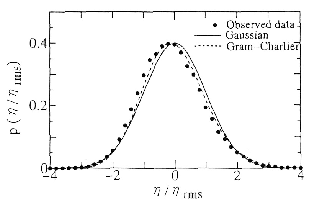
7 shows an example of comparisons of the PDF of the sea surface elevations among the observed data at Y871124, the Gaussian distribution, and 3rd order Gram-Charlier approximation.
Since, the signs of are positive, the peak of the PDF tend to shift toward the negative side. All the data examined are generally in amiable agreement with the Gram-Chalier distribution. Non of these implications, however, have a direct bearing on the incidence of freak waves.
=3.1-3.4.
A probability density function (PDF) of the sea surface elevation can signify macroscopic nonlinear characteristic of waves.
7 shows an example of comparisons of the PDF of the sea surface elevations among the observed data at Y871124, the Gaussian distribution, and 3rd order Gram-Charlier approximation.
Since, the signs of are positive, the peak of the PDF tend to shift toward the negative side. All the data examined are generally in amiable agreement with the Gram-Chalier distribution. Non of these implications, however, have a direct bearing on the incidence of freak waves.
 |
Alternatively, since freak waves are primarily transient events, conventional frequency spectrum analysis is clearly incapable in effectively processing rogue waves in the frequency domain. We applied wavelet transform analysis here to analyze the time series and examine the localized freak wave characteristics in the generalized time-frequency domain. Details on wavelet transform can now be found in many widely available introductory articles and texts (e.g. Liu, 2000; Mallat, 1998).
2-01 presents such a characteristic freak wave time series and its corresponding wavelet spectrum. The freak wave episode shown in 2-01(a) is represented by a plotting of 10 minutes time series segment that contains the occurrence of the freak wave along with a panel of corresponding contour plotting for the wavelet spectrum. It appears that for the well-defined freak wave as shown in the time series plot, it can also be readily identified from the wavelet spectrum where strong energy density in the spectrum appears instantly surged at the onset of the freak wave and the energy density seemingly carried over to the high frequency components at the freak wave instant. Therefore, for a given freak wave, there emerges a clear corresponding signature shown in the time-frequency domain of the wavelet spectrum. However, for another freak wave time series shown in 2-01(b), there is no corresponding instantaneous energy surge feature appear in the wavelet spectrum as those in 2-01(a). So it is somewhat uncertain in this case whether a freak wave identified only in the time series can be really considered as a freak wave or not. On the other hand, it is of interest to note that the time series in 2-01(a) at the onset of the freak wave its profile appeared rather asymmetric with respect to the mean level, whereas the freak wave profile in 2-01(b) was generally symmetric4. So the difference in wavelet spectrum might also be a result of the difference in freak wave profiles. Just as various different conjectures all can be shown to produce freak waves, freak waves certainly can be generated from different physical processes such as linear and nonlinear wave focusing. Time series alone clearly may or may not be relied on for distinguishing freak waves. While wavelet transform applied to the time series can provide further discernible features, it is still beyond the scope of the wavelet transform to readily comprehend the differences in possibly different processes. Undoubtedly more detailed measurements than just surface time series would be needed in order for proper and practical study of freak waves. At any rate, since the mechanism of freak wave formation is understandably diverse, it should not be surprising that different freak waves exhibit different qualitative features, linear or nonlinear.